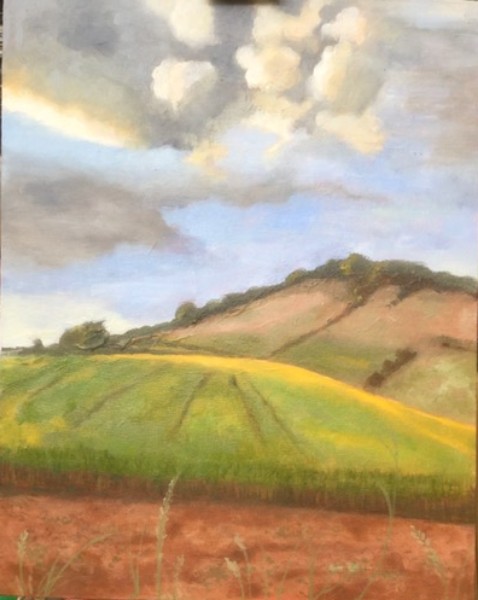
"Painting a landscape is an unusual one for me", writes Diana Woods-Humphery, " but one of the people I follow on Instagram posts lovely photos of Herefordshire and I was inspired by this which depicts a part of the countryside in the Fownhope area. I obtained permission from the photographer before painting this in water-soluble oils. I now have several other projects on the go!"
Showing posts with label landscape. Show all posts
Wednesday, 15 July 2020
Saturday, 2 May 2020
On sea and land
Mike Russell has sent in three paintings. “All have been painted in acrylics and photographed with an ordinary 35mm digital camera. The sailing boat is an image of a Bluenose schooner; these boats sailed out to the fishing banks of Newfoundland and launched small dories to do the fishing. Alas, only a replica remains, which I have seen sailing off Halifax, Nova Scotia. The fox is one of my wildlife paintings, although I usually paint birds. The mountain scenery is a stormy Brecon Beacons, a place I love. It was executed with palette knife, brush, toothbrush, spray and probably other tools as well. This is one of my largest paintings I think 24"x 20".”
| Bluenose schooner |
Labels:
acrylic,
landscape,
Mike Russell,
seascape,
wildlife
Wednesday, 15 May 2019
LEANNE ELLIS Acrylic Landscapes
We welcomed Leanne Ellis to the Society demo on 7th May.
Leanne is a demonstrator for both Winsor and Newton and Pebeo and provided a wide range of
materials for the Society members to buy. Leanne uses a maximum of 5 brushes and mixes acrylics on a specially designed palette, keeping her colour choices to a minimum.
Leanne's first canvas demonstration was a boat house on Lake Windermere. After roughly sketching in the outlines, she used cobalt blue for the sky, and a wide synthetic brush, she then added white for clouds in a loose fashion.
She then put in the hills and shadows, emphasising the need for these. Using Hookers Green (Mr Hooker was a famous plant hunter!) and buff titanium she highlighted the hills. Moving on to the lake using Payne's gray.
She showed how to create a realistic wood grain on the boat house with just a few strokes, then added the roof and trees with Hookers Green and burnt sienna. Creating the path and shadows, she used Alizarin crimson and Payne's gray to create the final scene. Then using her fingernails scratched grass.
For the second part of her demonstration Leanne used watercolour paper, which she wet to add light layers of acrylic. Creating a beach scene she showed techniques for creating rocks and people.
She concluded the morning by sharing a few tips on landscape painting with acrylics. She kindly presented the Society with one of her paintings for a future raffle prize.
Leanne is a demonstrator for both Winsor and Newton and Pebeo and provided a wide range of
materials for the Society members to buy. Leanne uses a maximum of 5 brushes and mixes acrylics on a specially designed palette, keeping her colour choices to a minimum.
Leanne's first canvas demonstration was a boat house on Lake Windermere. After roughly sketching in the outlines, she used cobalt blue for the sky, and a wide synthetic brush, she then added white for clouds in a loose fashion.
She then put in the hills and shadows, emphasising the need for these. Using Hookers Green (Mr Hooker was a famous plant hunter!) and buff titanium she highlighted the hills. Moving on to the lake using Payne's gray.
She showed how to create a realistic wood grain on the boat house with just a few strokes, then added the roof and trees with Hookers Green and burnt sienna. Creating the path and shadows, she used Alizarin crimson and Payne's gray to create the final scene. Then using her fingernails scratched grass.
For the second part of her demonstration Leanne used watercolour paper, which she wet to add light layers of acrylic. Creating a beach scene she showed techniques for creating rocks and people.
She concluded the morning by sharing a few tips on landscape painting with acrylics. She kindly presented the Society with one of her paintings for a future raffle prize.
Wednesday, 5 December 2018
Graham Wilson - Winter Landscape in Acrylic
This was Graham's second visit to us and, as before, he entertained us with the humorous manner in which he communicated his approach to painting. You can read about his previous demonstration here.
He often uses large canvasses for his acrylic paintings but favours a smaller scale for demonstrations. His support this time was mount card which he had coated with pink paint.
Ten images show the stages of his demonstration. He applied various widths of masking tape while he painted on a background, initially using white and then mixing into it on the support. When the tape was removed the position of the main tree trunks was marked by the pink undercoat. Pink was probably not a wise colour choice as he had difficulty covering it.
He often uses large canvasses for his acrylic paintings but favours a smaller scale for demonstrations. His support this time was mount card which he had coated with pink paint.
Ten images show the stages of his demonstration. He applied various widths of masking tape while he painted on a background, initially using white and then mixing into it on the support. When the tape was removed the position of the main tree trunks was marked by the pink undercoat. Pink was probably not a wise colour choice as he had difficulty covering it.
Wednesday, 11 April 2018
Frank Collict - painting with a palette knife
Frank had an early start from Penarth. He is primarily a landscape artist working in watercolour and oils. His work is about capturing the image with bold brush work while trying to convey the light and atmosphere of a place. Consequently, when painting in the field, he uses a limited palette to work quickly and keep things simple.
You can see more about his work on his website http://www.frankcollictart.com/
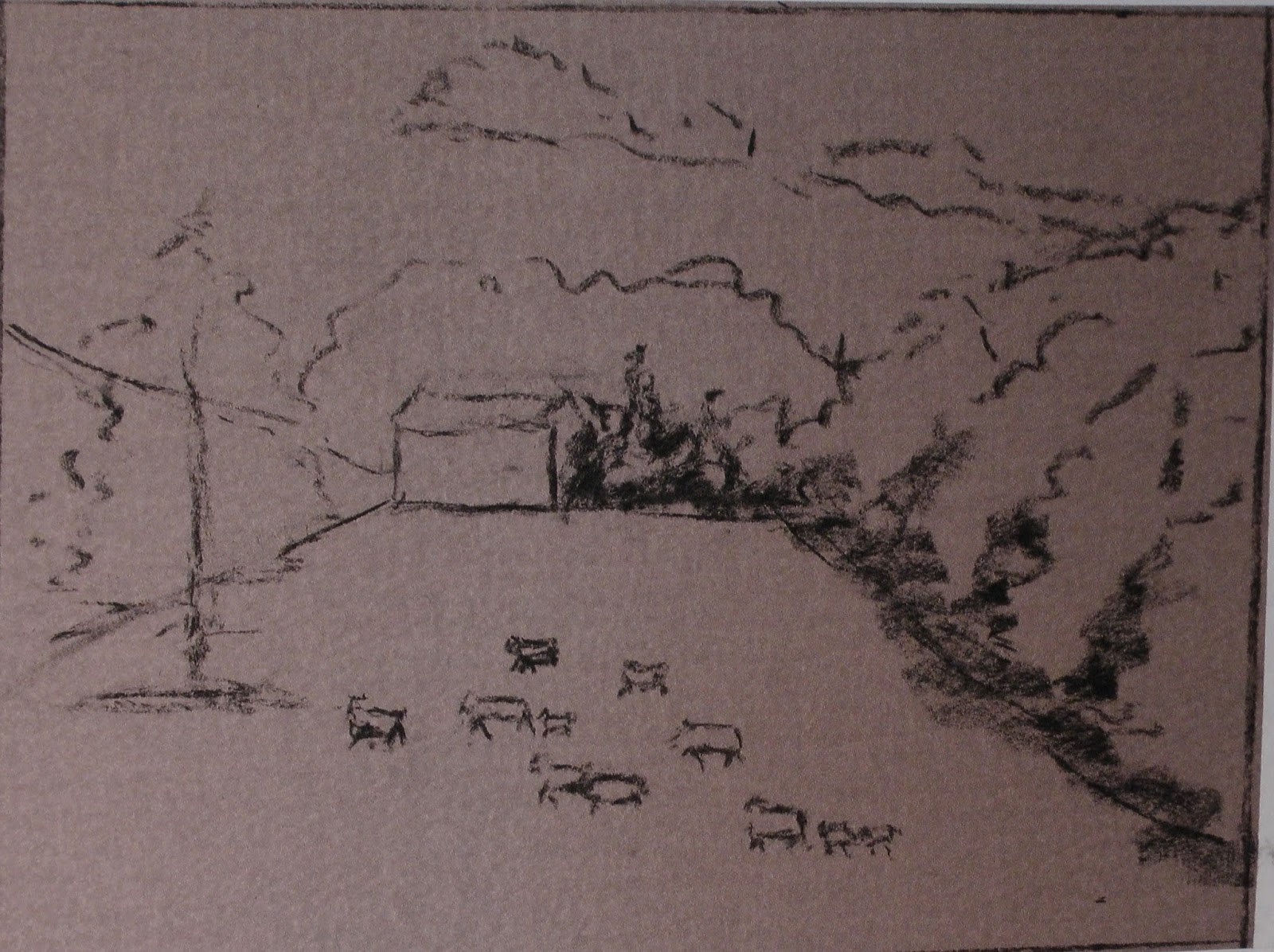
For this excellent demonstration he painted with palette knives. The first two images here show his starting sketch made in the field and a colour visual.
He was happy to answer questions as he painted, particularly when he had to spend time mixing paint on the palette, and he made sure we understood each step along the way.
For the demonstration he worked top to bottom and back to front but his approach in the studio is a bit different and he would usually spend much more time blending colours on the palette to make sure he achieved just the subtlety of colour and tone he wanted.
Frank stressed the importance of painting daily and working outdoors as much as possible. He felt that his painting had developed very quickly once he had plucked up the courage to work outdoors and his work became much more spontaneous, particularly his watercolours. Working with a palette knife had also contributed to the spontaneity of approach, particularly in forcing him to simplify.
Labels:
demonstration,
Frank Collict,
landscape,
oils,
palette knife
Thursday, 9 November 2017
Marion Yeo - Acrylic Landscape
Marion Yeo is a Worcester based artist who uses nature as her inspiration. Her reference photo for the demonstration was of a forest in Cornwall.
She usually lays down some colour on her canvas before beginning a painting. In this instance she has used a two-tone background.

The next step is to indicate some of the main features - in this case the edges of the river and the tree trunks and larger branches. This was done using Payne's Grey.
She kept us well entertained with a series of quotations and stories as well as describing her working methods.
She continued to add darker values and then added some white for parts of the river and as an under-painting for brighter leaves.
She usually lays down some colour on her canvas before beginning a painting. In this instance she has used a two-tone background.

The next step is to indicate some of the main features - in this case the edges of the river and the tree trunks and larger branches. This was done using Payne's Grey.
She kept us well entertained with a series of quotations and stories as well as describing her working methods.
She continued to add darker values and then added some white for parts of the river and as an under-painting for brighter leaves.
Labels:
acrylic,
demonstration,
landscape,
Marion Yeo
Friday, 10 February 2017
Carole Baker: Landscape in Acrylic
Our demonstrator for February was Carol Baker http://www.carolebaker.com/ who tackle a landscape using a scumbling technique to apply thin layers of acrylic paint.
Carole does a lot of plein air sketching and uses her sketch book to plan her studio paintings. The image to the left shows a thumbnail and a water colour sketch for the painting she demonstrated.
Notice also that the sketchbook shows what she has chosen as her palette for this painting. As well as three primaries, she has a light violet, white and Paynes Grey.
She always works with a limited palette and keeps a stack old Ferrero Rochet boxes with a different selection of paints in each. Here's the one she used for the demonstration.Her support was an MDF board primed with brushed on gesso, which gives some texture, and then coated with emulsion applied with a roller. She had then applied an underpainting using a mixture of the red and Naples Yellow from her palette and would expect some of that to orange to show through and add some dynamism to the picture.
The following images show the development of the painting.
Labels:
acrylic,
Carole Baker,
demonstration,
landscape
Thursday, 12 January 2017
Valerie Briggs - Pastel demonstration
![]() |
| A misty start to the day |
Her first is shown on the left. Both this and the subsequent painting were produced without reference materials. She obviously has an excellent visual memory which, I'm sure, is the result of well developed observational skills.
Before starting she gave us some useful guidance on types of pastels and the various supports available and how well they held the pigment. It seems the "dreaded velour" sheds the pigment rather rapidly. The demonstrations were on Canson Mi-Teintes. Looking at the images of the second demo painting I can see that the right hand edge of the paper is lightly embossed with the brand name - probably not something you would want to show up in your work.
Labels:
demonstration,
landscape,
pastel,
Valerie Briggs,
wildlife
Tuesday, 6 September 2016
Marion Derrett: Pastel Landscape
Marion often takes photographs for reference, which she usually crops and then develops thumbnail sketches if she wishes to adjust the composition. She brought with her the photo and thumbnails for the landscape she demonstrated today and had also sketched the scene with charcoal on the sanded paper support she used.
She began by putting in the darkest values and then added various blues to the sky - darkest at the side from which the light came. Notice the purple on the underside of the clouds.
Labels:
demonstration,
landscape,
Marion Derrett,
pastel
Thursday, 3 September 2015
Tim Nash - Landscape in Mixed Media
Our Autumn/Winter programme got of to an excellent start with Tim Nash demonstrating how he works in mixed media.
What you see above is the end of a journey that began with looking at several textured surfaces including several old paintings that could be distressed and changed in a variety of ways to make them more interesting.
The painting surface of choice was mount board to which torn up pieces of textured wall-paper had been added using PVA. Generally, the textured paper was added to the lower half of the board so that a 'quieter' area was left elsewhere.
You can get some idea of the textures from the image on the right here, particularly if you zoom in.
And, yes, there is a painting that looks suspiciously like the one we ended up with!
But on closer inspection it proves to be far less interesting.
You can see that more clearly in the next image.
Labels:
demonstration,
landscape,
mixed media,
Tim Nash
Wednesday, 15 April 2015
David Wilcox - Landscape in Watercolour
Landscapes are not what we associate with David Wilcox. He is, and sees himself as, a figure painter. Last time he came to us it was dancers in watercolour. This was his first landscape demonstration and the first time in a long while that he had attempted a landscape, though he used to produce many when he lived in Devon. He based his demonstration painting on two photographs: one a Dartmoor village, the other a snow scene painting he had done back in the 1980s.
David works very loosely in watercolour and for his sky he worked quite quickly wet-in-wet. Having his board nearly vertical led to some challenges as wet paint ran rather too readily from the sky. The next step was to wash in some greens for the foliage and then he moved on to put in some shadows on the buildings before adding some texture to them. Once he had added darks for the yew trees in the churchyard the battle to balance out tonal contrasts began. There were several occasions where he found some areas were not dark enough. I'm sure for several of us this is a familiar process when a painting needs constant adjustment.
Yet again, a good demonstration. Attendance was not so good with only sixteen members present on this occasion. It was probably too soon after Easter.
The images that follow show David's paintings at various stages of progress.
David works very loosely in watercolour and for his sky he worked quite quickly wet-in-wet. Having his board nearly vertical led to some challenges as wet paint ran rather too readily from the sky. The next step was to wash in some greens for the foliage and then he moved on to put in some shadows on the buildings before adding some texture to them. Once he had added darks for the yew trees in the churchyard the battle to balance out tonal contrasts began. There were several occasions where he found some areas were not dark enough. I'm sure for several of us this is a familiar process when a painting needs constant adjustment.
Yet again, a good demonstration. Attendance was not so good with only sixteen members present on this occasion. It was probably too soon after Easter.
The images that follow show David's paintings at various stages of progress.
Labels:
David Wilcox,
demonstration,
landscape,
snow,
watercolour
Sunday, 8 February 2015
Geoff Rowswell - watercolour landscape
![]() |
| The finished painting |
Geoff encouraged us toward a looser style and the omission of too much detail.
Two things particularly impressed me with the demonstration were: [1] the use of a very limited palette (I think he used only Ultramarine, Burnt Sienna and Raw Umber); [2] the light that seems to shine out of this picture.
Geoff had done his drawing in advance and had applied masking fluid to the trunks of the foreground birches. The images that follow show the progress of the painting.
Saturday, 7 December 2013
Charles Evans - Watercolour Landscapes
![]() |
| Lindisfarne Castle |
His approach is quite literally broad brush - he only had four brushes and although his support was almost vertical throughout that didn't create any problems. Any runs or large beads were soon picked up with the tip of a 1½" brush.
Once he had completed this painting he show us some techniques and after the break did a painting of Alnwick Moor in just 20 minutes. As well as my photos which show step by step progress of the two paintings in this demonstration you can see more on the News page of his website http://www.charlesevansart.com/index.htm
Labels:
Charles Evans,
demonstration,
landscape,
watercolour
Friday, 25 October 2013
Nigel Street - landscape in watercolour
On Tuesday I enjoyed a morning with Hereford Art Group watching Nigel Street demonstrate how he paints landscapes in watercolour. Although at the end of the session he had not quite finished, we gained a clear idea of where he was going and picked up some useful tips along the way.
Having taken part in one of Nigel's Understanding Watercolour weekends a year ago, it was good to get some reminders even though I have a slightly guilty conscience about how little watercolour painting I've done in the last year. For more information on his courses visit Nigel's website.
Hereford Art Group paint most Tuesdays and only have a couple of demonstrators a year: very different from Ledbury Art Society where demonstrations and occasional workshops are the normal pattern.
Nigel's standard landscape palette is worth a mention. He uses plastic palettes with deep wells set out in a 6x2 grid. In the two wells furthest from him he puts pigments useful for atmosphere and distance: cobalt blue light and raw umber (insoluble opaque). The soluble transparent colours are arranged on the left so coming forward from the cobalt blue he has phthalo blue, sap green (which is an optional addition to the basic palette), primary yellow and alazarin crimson or permanent dark red. Notice how the order takes you from background to foreground. At the very front of the palette he has French ultramarine and burnt sienna (insoluble and dense). Yellow ochre is an optional addition which he places to the right of the primary yellow. This is insoluble and opaque and is a good carrier of colour.
| Not quite finished |
Having taken part in one of Nigel's Understanding Watercolour weekends a year ago, it was good to get some reminders even though I have a slightly guilty conscience about how little watercolour painting I've done in the last year. For more information on his courses visit Nigel's website.
Hereford Art Group paint most Tuesdays and only have a couple of demonstrators a year: very different from Ledbury Art Society where demonstrations and occasional workshops are the normal pattern.
Nigel's standard landscape palette is worth a mention. He uses plastic palettes with deep wells set out in a 6x2 grid. In the two wells furthest from him he puts pigments useful for atmosphere and distance: cobalt blue light and raw umber (insoluble opaque). The soluble transparent colours are arranged on the left so coming forward from the cobalt blue he has phthalo blue, sap green (which is an optional addition to the basic palette), primary yellow and alazarin crimson or permanent dark red. Notice how the order takes you from background to foreground. At the very front of the palette he has French ultramarine and burnt sienna (insoluble and dense). Yellow ochre is an optional addition which he places to the right of the primary yellow. This is insoluble and opaque and is a good carrier of colour.
Thursday, 3 October 2013
Jon Davis - landcape in pastel and acrylic
I'm always fascinated by the many approaches taken by the different demonstrators who come to us each month. Jon Davis had prepared an canvas board by painting it with white acrylic and he already had the basic scene depicted in light black. Only the sky has been added roughly at this point in the demonstration.
Jon studied classical portrait painting in the studio of Ken Paine. While we were setting up Jon told me how that came about. He had seen Ken working and rather rudely tapped him on the shoulder and asked what he was using. "Pastels.", was the reply and after a searching gaze Ken then asked "When's your birthday?" A date was named and Ken then announced "I've been waiting 20 years for you." They shared a birthday as did Ken with his tutor and so on back through several generations.
Labels:
acrylic,
demonstration,
landscape,
mixed media,
pastel
Saturday, 17 November 2012
Acrylic Landscapes - Sue Townsend
The next image shows her own reference photo and then there are three at various stages of progress. After that comes a selection of images showing work in progress by workshop participants and then some where they are obviously hard at work.
Labels:
acrylic,
landscape,
Sue Townsend,
trees,
workshop
Subscribe to:
Posts (Atom)